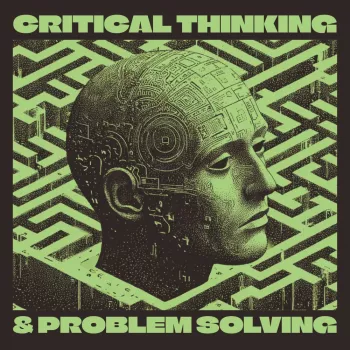
Better decisions rarely come from having more information; they come from thinking more clearly with the information already available. A practical critical thinking routine helps spot weak assumptions, reduce impulsive choices, and solve problems faster—at work, at home, and in personal goals. This guide breaks down what to practice, how to build the habit, and how a focused digital eBook can provide structured exercises, brain teasers, and repeatable frameworks for real-life situations.
Critical thinking isn’t about sounding logical—it’s about staying oriented to reality when you’re busy, stressed, or emotionally invested. In everyday decisions, it often looks like:
If a decision feels “stuck,” it’s usually because the problem statement is fuzzy, the constraints are unspoken, or the criteria for “good enough” were never defined. A simple written prompt can instantly clarify what’s actually being decided.
For a formal reference point, the APA describes critical thinking as “purposeful, reasoned, and goal-directed” thinking, which matches the practical focus of making decisions that hold up under scrutiny (APA Dictionary of Psychology).
Even smart people fall into predictable traps—especially when time is short, stakes feel high, or a decision touches identity and pride. Watch for these patterns:
| Trap | Quick self-check | Simple correction |
|---|---|---|
| Confirmation bias | “What evidence would change my mind?” | List 3 disconfirming facts to find |
| Sunk cost | “If starting today, would I choose this?” | Decide using forward-looking costs/benefits |
| Overconfidence | “What am I assuming is certain?” | Assign probabilities; seek outside base rates |
| Binary framing | “What’s option C?” | Generate 5 alternatives before evaluating |
| Availability | “Is this typical or just memorable?” | Look for broader data or multiple examples |
When problem-solving feels overwhelming, the fix is usually structure. A simple loop keeps thinking grounded and prevents jumping from “anxiety” straight to “action.”
For diagnosis, it can help to visualize cause-and-effect rather than relying on memory. Fishbone (Ishikawa) diagrams are a practical way to map potential causes before choosing an intervention (NIST/SEMATECH e-Handbook).
Brain teasers aren’t magic, but they are useful when they reinforce a method instead of just chasing a clever answer. Used consistently, they can:
The key is reflection: after solving a puzzle, note what made it hard (hidden constraints, assumptions, misdirection) and then apply that lesson to a current real-world choice.
A strong digital guide makes practice easier than avoidance. Look for:
If you want a ready-to-use system with structured exercises and real-life decision support, explore the Critical Thinking & Problem Solving eBook (digital download).
For entrepreneurs and side projects, the same critical thinking tools also improve idea selection and validation. A structured companion resource for opportunity evaluation is the Find Your Next Big Business Idea Toolkit (Ebook).
Philosophical treatments of critical thinking emphasize disciplined evaluation of reasons and arguments—useful when decisions are emotionally charged or socially pressured (Stanford Encyclopedia of Philosophy).
A well-designed eBook can be enough if it includes repeatable frameworks, practice exercises, and reflection prompts that make you apply the tools to real decisions. Courses can add feedback and accountability, but self-paced repetition is often the main driver of improvement.
Many people notice stronger awareness of biases within a few weeks, especially when using a decision log. More reliable habits typically form over 1–3 months of consistent practice and applying at least one tool to a real situation each week.
They translate best when puzzles teach a method (constraints, logic steps, checking edge cases) and each exercise includes a brief prompt to apply the same thinking to a real scenario. Without that reflection step, the benefit can stay limited to the puzzle itself.






Leave a comment